
Beyond the Bubbles: Entrained Air and Foam Will Silently Destroy Machinery
Entrained Air and Foam Problems Will Disrupt Lubrication and Destroy Lubricants
Foam resting on the surface of an oil reservoir is often dismissed as normal condition as a turbulent fluid rests before recirculating through a lube system. Most likely the visible foam will dissipate before re-circulating, but that foam is often just the visible symptom of a much more destructive, invisible problem: entrained air. Air in your oil is harmful. It is a "silent killer" that actively destroys lubricants and significantly disrupts normal lubrication of equipment components. Excess entrained air reduces the normal life of a lubricant, reduces machine efficiency, and can lead to catastrophic hardware damage.
The Three States of Air in Oil
- Dissolved Air: All lubricants naturally contain dissolved air, much like carbon dioxide is dissolved in a can of soda. Under normal conditions dissolved air is not a problem. However, when pressure drops or temperature rises, this air can come out of solution and form bubbles.
- Entrained Air is an enemy to lubrication. Entrained air consists of microscopic-size bubbles that are mixed and suspended within the bulk of the oil. These bubbles are often so small they are not visible to the naked eye, creating a "hazy" or "milky" appearance. This type of air forms in bubbles that are too small to rise to the surface and escape.
- Foam is a condition that you can see on the surface. Foam is a collection of larger air bubbles that have risen to the surface of the fluid. While excess foaming the most obvious sign of a problem, foam itself is less destructive than the entrained air still circulating in the system.
Think of it this way: Foam is a symptom, although entrained air is a disease.
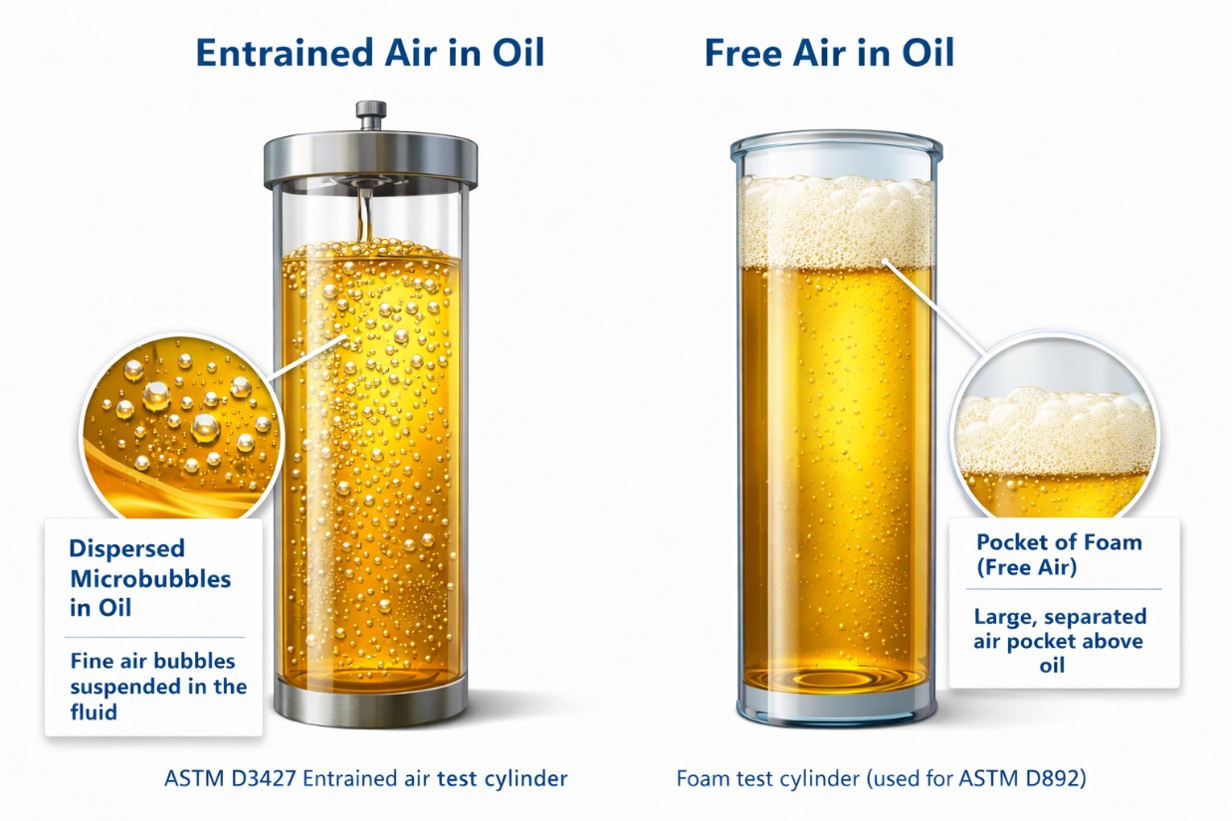
Figure 1. Entrained air and foam.
Why is Entrained Air a Problem?
Rapid oil degradation to catastrophic hardware failure are the most destructive, and least understood, consequence of entrained air. As a microscopic air bubble circulates through the system, it moves from a low-pressure area (like the pump suction) to a high-pressure zone (such as a hydraulic actuator or roller-element bearing). The bubble undergoes rapid adiabatic compression— generating immense, localized heat, often exceeding 1,000°F (540°C).
This intense heat flash instantly burns (oxidizes) the thin film of oil surrounding the bubble. This process, called micro-dieseling, which is a primary source of varnish and sludge creating from degrading lubricant. These degradation by-products cause sticking valves, plugged filters, and poor heat transfer. Entrained air causes pump cavitation, accelerated oil oxidation, disrupted lubrication and spongy hydraulic actuation.
Air bubbles flowing into a pump are a classic recipe for cavitation. As entrained air bubbles violently collapse when moving from the low-pressure suction side to the high-pressure discharge side. This collapse creates a micro-jet of fluid that impacts component surfaces with extreme force, physically blasting away metal and eroding pump internals. If a pump is cavitating. the pump often sounds like it is “pumping gravel.”
Accelerated lubricant oxidation occurs when oil reacts with excess oxygen. Entrained air dramatically increases the surface area of oil exposed to oxygen, especially at high operating temperatures. This hyper-accelerates oxidation, depleting additives and shortening the lubricant's service life.
Air is not a lubricant. When an air bubble passes through a critical load zone, like a bearing or gear teeth, it displaces the oil film and disrupts lubrication. For a split second, that component is running with no lubricant, leading to metal-to-metal contact and abrasive wear. In hydraulic systems, this problem is even more immediate. Lubricant is non-compressible, but excess entrained air is compressible. Entrained air in a hydraulic line will leads to “spongy" control actuation, causing major operational and safety issues.
What Creates Entrained Air and Foam?
When you see foam or suspect entrained air in a lubricant, the root cause is almost always either a mechanical or a fluid condition issue:
Mechanical Issues
- Low oil level: The pump is sucking in air from the top of the reservoir.
- Air leaks: A loose fitting or bad seal on the suction side of a pump is pulling in air.
- Splashing: The oil return line is dropping oil from a height ("plunging"), churning air into the reservoir.
- Excessive agitation: In a gearbox, over-filling can cause the gears to churn the oil like a blender.
Fluid Problems
- Contamination: Water, dirt, or even cross-contamination with the wrong fluid can destroy the oil's surface tension and ability to release air.
- Additive Depletion: The anti-foam additive in the oil is depleted. This can happen over time or be stripped out by certain filter types.
- High Viscosity: The oil is too thick (wrong grade) or has become too thick (due to oxidation), making it physically harder for air bubbles to rise and escape.
A proper oil analysis program provides very useful data about foaming and air entrainment that can direct appropriate action to fix an issue.
Foaming Tendency Test (ASTM D892): This test measures an oil's tendency to foam and the stability of that foam once it's created. This is the standard test for checking the remaining usefulness of your anti-foam additives.
Air Release (ASTM D3427): This is the single most important test for diagnosing entrained air. The oil analysis lab will bubble air through an oil sample (using the correct equipment and procedure) to measure how many minutes it takes for entrained air to escape. That air release time should be equal or just slightly longer than new fluid. An OEM will often provide the air release time of a particular lubricant. A new oil might have an air release time of 3-5 minutes, while a degraded or contaminated in-service oil might take 15, 20, or even 30 minutes. That extended time means those destructive micro-bubbles are circulating through your system, creating varnish and causing cavitation. Air release time needs to be shorter than the dwell time in a reservoir, otherwise air will not fully evacuate the resting fluid in a circulating system.
Karl Fischer Water (ASTM D6304): Checks for water contamination, a common cause of foaming.
Viscosity (ASTM D445): Confirms the correct oil grade is being used.
MPC Varnish Potential (ASTM D7843): A high varnish reading is a major symptom of ongoing micro-dieseling caused by entrained air.
Before adding a product to a lubricant to stop foam or entrained air issues, perform a structured root-cause analysis on the system.
- Inspect Your Machine: Check oil levels, look for suction-side leaks, and make sure the return lines are submerged below the oil level.
- Test Your Oil: A comprehensive lab analysis is a useful way to learn whether the cause is mechanical (leaks or over-agitation) or fluid-based (contamination, dead additives).